
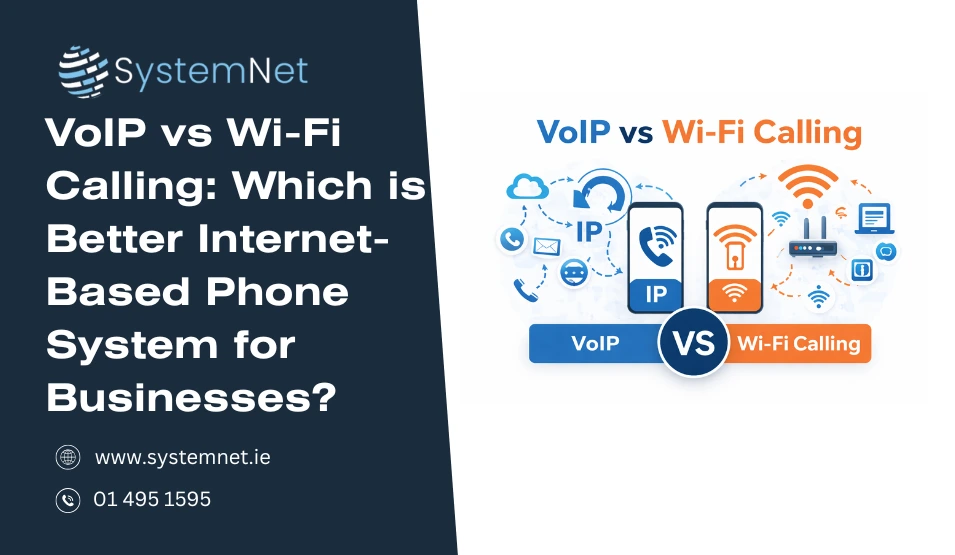
VoIP is the better choice for business communication, while Wi-Fi calling is designed mainly for personal use.
What Is VoIP? (Voice over Internet Protocol)
VoIP, or Voice over Internet Protocol, is a technology that allows businesses to make voice calls using the internet instead of traditional phone systems. You can use VoIP calls on mobile phones, laptops, desk phones, or softphones, basically any device compatible with VoIP technology.
Instead of using physical phone lines, VoIP uses your internet connection to handle all inbound and outbound calls. It also provides professional features such as call recording, call routing, voicemail-to-email, IVR menus, call queues, and the ability to receive calls from anywhere.
What Is Wi-Fi Calling?
Wi-Fi Calling is a mobile carrier feature that allows your smartphone to make phone calls through a Wi-Fi network when the mobile signal is weak. It uses your same phone number, your built-in dialer, and works only on a mobile phone, not on laptops or desk phones.
Wi-Fi Calling is best described as a backup feature for personal mobile users. When your home or office has a weak mobile signal, your phone automatically switches to Wi-Fi for better voice quality. However, it offers no business features and no ability to manage multiple employees, extensions, or professional calling offers.
Key Difference Between VoIP and Wi-Fi Calling
| Feature | VoIP | Wi-Fi Calling |
|---|---|---|
| Works Through | VoIP apps, softphones, desk phones | Smartphone’s built-in dialer |
| Carrier Dependent | No | Yes |
| Multi-User Support | Yes | No |
| Business Features | Extensive | None |
| Works on Multiple Devices | Yes | No |
| International Calls | Low-cost | Follows mobile plan rules |
| Designed For | Business communication | Personal/mobile calling |
How VoIP Works for Businesses?
- Voice conversion: Your voice is converted into digital packets using VoIP technology.
- Internet transfer: These packets travel over your broadband or Wi-Fi connection.
- VoIP server routing: The VoIP phone service routes the call to the receiver (mobile, VoIP, landline).
- Call management features: Call recording, call forwarding, queues, and IVR operate simultaneously in the background.
- Multi-device access: You can answer or receive calls from laptops, mobiles, or VoIP desk phones.
- Remote accessibility: Employees working anywhere can log in and stay connected without exposing personal phone numbers.
VoIP works because it does not rely on mobile network coverage; it relies on stable internet. This makes it ideal for offices, restaurants, and remote teams in Ireland.
Is Wi-Fi Calling Suitable for Business?
- Phone connects to Wi-Fi when the mobile network is weak.
- Your carrier handles routing, not a VoIP server.
- Call passes through your mobile plan, not your business system.
- No multi-user management, so your team cannot collaborate on one business phone number.
- No business features like call queues, analytics, or routing.
- Works only on mobile phones, not on desk phones or desktops.
Wi-Fi calling is a personal convenience feature, not a structured communication system for organisations.
What Businesses Typically Need from a Phone System
Every business in Ireland, whether a restaurant, retail store, medical clinic, or service provider, has professional communication requirements. A business phone system must support:
1. Inbound Needs
- Handling high volumes of incoming calls
- Queues for busy times
- Calling offers like IVR (“Press 1 for reservations”)
- Consistent call quality
2. Outbound Needs
- Call recording for training
- Clear caller ID
- Ability to call customers from a business number
- Tracking staff performance
3. Operational Needs
- Ability to assign extensions to staff
- Call transfer between team members
- Multi-location support
- Analytics and reporting
- Phone number portability
- 24/7 accessibility even during power or network issues
VoIP meets these needs. Wi-Fi calling does not.
Do VoIP Systems Meet These Needs?
Yes, VoIP systems are built for business communication. They allow teams to handle inbound and outbound calls, manage customer queries, and maintain professional call quality.
VoIP supports:
- Business phone numbers
- Multi-user access
- Professional features such as call recording, call logs, and auto-attendant
- Desk phones or mobile apps
- Centralised communication across branches
- Work-from-anywhere model
If your business needs structure, scalability, and reliability, VoIP meets every requirement.
Do Wi-Fi Calling Systems Meet These Needs?
No, Wi-Fi calling is not a business-grade communication tool. It simply allows a mobile phone to make calls when the mobile network fails.
Limitations include:
- No call queue
- No multi-user support
- No shared phone numbers
- No analytics
- No desk phone support
- No integration with business software
If you run a team, department, or customer-facing service, Wi-Fi calling is not suitable.
Feature-by-Feature Comparison: VoIP vs Wi-Fi Calling
Call Quality
VoIP delivers consistently clear voice calls when supported by stable broadband, offering reliable quality for continuous business operations and customer communication throughout the workday.
Wi-Fi Calling depends solely on smartphone hardware and Wi-Fi strength, often causing drops or distortion during peak usage or weak connection areas, making it unreliable for business needs.
Reliability
VoIP provides strong reliability through multi-device access, backup routing, and stable internet-based performance that ensures teams can handle inbound and outbound calls without interruption.
Wi-Fi Calling remains reliable only with strong Wi-Fi coverage, frequently dropping when switching networks or moving between rooms, reducing overall dependability for business communication.
Device Flexibility
VoIP supports a wide range of devices including desk phones, softphones, laptops, and mobiles, allowing staff to manage calls from anywhere with maximum flexibility.
Wi-Fi Calling is limited to the smartphone’s built-in dialer and cannot operate across multiple devices, restricting how teams access and manage business phone calls.
Scalability (Growing Teams)
VoIP easily scales with growing teams by adding users, extensions, and departments, allowing businesses to expand communication systems without costly physical lines.
Wi-Fi Calling cannot scale across multiple users or departments, offering no structured expansion options and remaining suited only for individual, personal-level calling.
Real Business Scenarios
Front Desk / Reception
Receptionists need to transfer calls, place callers on hold, manage high volumes, and maintain a professional caller ID. VoIP works. Wi-Fi calling doesn’t.
Delivery & Customer Support
Restaurants and shops receive order updates, complaints, and delivery confirmation calls.
VoIP provides call queues, recordings, and multi-user access.
Wi-Fi calling cannot support a team environment.
Multi-Branch
Businesses with multiple branches need a unified phone number, shared extensions, and centralised management.
Only VoIP offers this.
Remote / Hybrid Staff
Teams working from home or different cities need access to the same phone number.
VoIP supports this through apps and softphones.
Low Network Indoor Areas
Some restaurants have concrete walls or basement kitchens with no mobile network.
VoIP solves this problem by using broadband.
Security, Privacy & Compliance
VoIP provides enterprise-level security with encryption, user access controls, secure routing, and compliance with modern standards. On the other hand, Wi-Fi calling depends entirely on your mobile carrier’s security and offers no business-level privacy controls.
How to Choose the Right System for Your Business?
Choose VoIP if you need:
- Multi-user call handling
- Professional phone numbers
- Call recording
- Desk phone options
- Department extensions
- Multi-location support
- Predictable costs
Choose Wi-Fi calling only if:
- You are a single user
- You just want to improve personal call quality
- You do not need business features
Looking for Reliable Business Phone System in Ireland?
If your business needs a stable, cloud-based communication system that supports professional calling, advanced features, and multi-user management, SystemNet provides one of the most reliable VoIP phone systems in Ireland for businesses.
Talk to our team to understand which phone setup fits your business structure.
Key Takeaways
- VoIP is built for business; Wi-Fi calling is for personal use.
- VoIP offers business features like call recording, routing, extensions, and analytics.
- Wi-Fi calling has no multi-user support and cannot run a business phone system.
- VoIP works on multiple devices; Wi-Fi calling works only on smartphones.
FAQs
Q. Does VoIP work without mobile network coverage?
Yes, VoIP works fully on broadband or Wi-Fi with no mobile signal needed.
Q. Can I use the same business phone number on multiple devices?
Yes, VoIP supports shared numbers across mobiles, laptops, and desk phones.
Q. Does Wi-Fi calling support call recording?
No, Wi-Fi calling cannot record calls or provide business-level analytics.
Q. Is VoIP cheaper for international calls?
Yes, VoIP offers significantly lower international calling charges than mobile networks.
Q. Do I need special hardware for VoIP?
No, You can use mobile apps, laptops, or optional VoIP desk phones.
Q. Can I call UK numbers from Ireland using VoIP?
Yes, VoIP allows UK calling at affordable rates with stable call quality.