
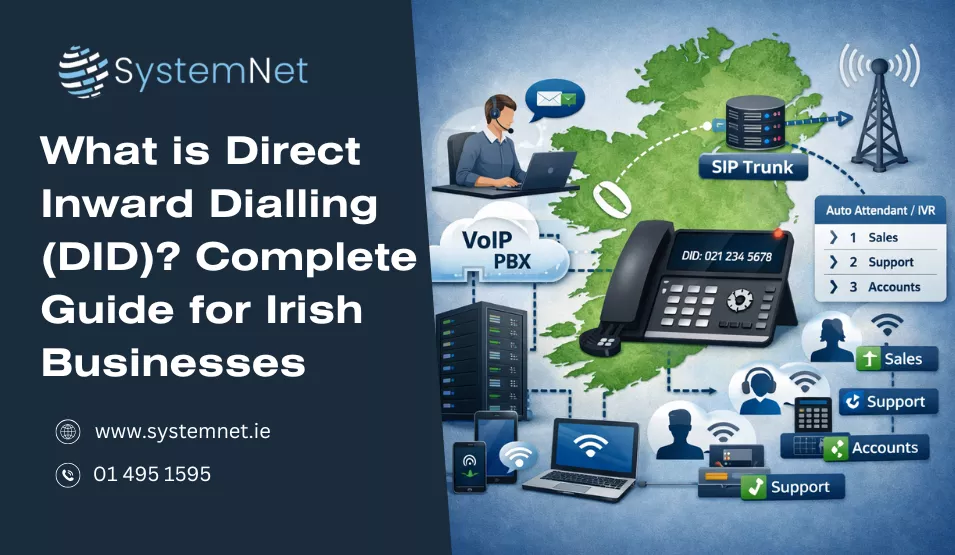
Direct Inward Dialling (DID) is a modern telephony feature that allows businesses in Ireland to assign individual phone numbers to staff or departments without needing separate physical telephone lines.
If you’re trying to understand how calls reach the right person instantly, this guide explains everything about Direct Inward Dialling.
What is a DID Number?
A DID number, known internationally as Direct Inward Dialling, is a dedicated inbound number that routes calls directly to a person, department, or extension inside a business phone system. Instead of all calls going to a single receptionist, a DID ensures that each dialled number goes straight to the intended recipient without manual handling.
In traditional telephony, telephone companies had to install multiple telephone lines for multiple numbers. With DID, this is no longer needed. The routing happens digitally, using VoIP technology, SIP trunk connections, or cloud-based PBX systems.
How Does DID Work Digitally in VoIP?
In VoIP and cloud-based telephony, DID numbers operate through digital routing:
- A caller dials a DID number
- The number is recognised over SIP (Session Initiation Protocol)
- Your company’s Cloud PBX receives the incoming call
- The PBX maps the number to a specific extension or user
- The call is delivered to a VoIP phone, desk phone, or softphone app
This system removes the dependency on the public switched telephone network (PSTN) and replaces it with a fully digital process that is faster, scalable, and significantly more flexible.
How Direct Inward Dialling Works in Business Phone Systems?
Understanding DID becomes easier once you look at how the call travels. Whether you’re using on-premise PBX systems, Cloud PBX, SIP trunking, or PRI circuits, DID follows a similar flow.
1. Caller Dials the DID Number
The call originates from a mobile or landline and enters the PSTN or VoIP network.
2. The Carrier Routes the Dialled Number
The carrier identifies the DID number and sends it to your business through:
- SIP trunk (modern method)
- PRI circuits (older method)
- Virtual DID routing (cloud-based)
3. Your PBX Receives the Inbound Call
The company’s private branch exchange (PBX) or Cloud PBX determines where the call should go.
4. PBX Sends the Call to the Correct Extension
Examples:
- Sales team
- Accounts department
- Support helpdesk
- Individual employee
- Ring groups
- Auto attendant / IVR
5. The User Answers on Any Device
Depending on the setup, calls can ring on:
- Desk phones
- VoIP phones
- Softphone applications
- Mobile apps
- Remote laptops
This makes DID perfect for hybrid teams, remote staff, and multi-location offices across Ireland.
Why Businesses Use DID Numbers: Key Benefits
Irish businesses rely on DID numbers because they simplify communication, reduce operational costs, and improve customer experience.
1. Direct Calling to Staff & Departments
Instead of every inbound call hitting reception, DID allows callers to reach:
- Sales
- Billing
- Support
- Delivery
- Individuals
No manual call transfers are required.
2. No Need for Separate Telephone Lines
With DID, you do not need multiple trunk lines or separate PRI circuits for every number. One SIP trunk can carry multiple DID numbers digitally.
3. Faster Customer Experience
DID reduces wait times for callers because they reach the correct person immediately.
4. Professional Communication Flow
Businesses appear larger, structured, and well-organised when each team has its own direct number.
5. Supports Remote and Hybrid Teams
Employees can answer inbound calls from:
- Home
- Office
- Mobile
- Overseas locations
6. Cost Savings & Simplified Scaling
Adding a new DID number is cheaper than installing a new telephone line. For growing Irish businesses, this is one of the most practical advantages.
DID Numbers in VoIP Systems & Why It Matters Today?
With Ireland shifting rapidly to cloud-based communication, DID has become essential.
1. Modern VoIP Architecture Depends on DID
DID enables smooth inbound call routing within VoIP environments using SIP trunking and cloud PBX frameworks.
2. Compatible with Cloud PBX
Digital systems allocate and manage DID numbers without hardware changes.
3. Supports Multi-Location & Remote Teams
Whether you have staff in Dublin, Cork, Galway, or working remotely, DID numbers route calls seamlessly.
4. Works with Auto Attendant & IVR
DID integrates with features such as:
- Auto attendant
- Department selection menus
- IVR call flows
- Queue systems
5. Requires No Physical Infrastructure
Everything is managed virtually, making DID ideal for:
- Startups
- SMEs
- Enterprise teams
- Cloud-first companies in Ireland
Benefits of DID for Irish Businesses
Here are the most important advantages specifically for businesses operating in Ireland:
1. Local Irish Numbers for Customer Trust
Businesses can choose DID numbers such as:
- 01 (Dublin)
- 021 (Cork)
- 061 (Limerick)
- 091 (Galway)
This boosts confidence for callers during inbound calls.
2. Multi-Staff Extensions Without Extra Lines
Multiple employees can share a single SIP trunk while still keeping separate DID numbers.
3. Remote Work & Mobile Flexibility
Irish businesses increasingly rely on mobility, and DID supports answering calls from anywhere.
4. Better Customer Experience
Faster call routing ensures customers reach the correct person quickly.
5. Scalable for Growing Teams
As your team expands, you can add:
- More departments
- More DID numbers
- More users
Without changing your telephone service infrastructure.
6. Works with Toll-Free Numbers
DID can complement 1800 or 0818 numbers, giving a unified calling experience across Ireland.
DID Number vs Regular Phone Number: What’s the Difference?
| Feature | DID Number | Regular Phone Number |
|---|---|---|
| Routing Method | Routes directly to an extension, user, team, queue or IVR | Rings one main line or receptionist |
| Lines Required | No physical telephone lines needed (digital via SIP trunk) | Requires separate telephone line for each number |
| Scalability | Fully scalable, add numbers instantly | Limited, more lines require physical installation |
| Cost | Low-cost, digital, efficient | Higher monthly line rental charges |
| Use for Remote Work | Works on VoIP phones, softphones, mobile apps | Usually requires the phone to be physically in the office |
| Best For | SMEs, multi-department teams, remote staff | Very small businesses or single-line users |
| Flexibility | Redirect calls anytime using Cloud PBX | Limited call-forwarding capability |
| Integration | Works with IVR, auto attendant, call queues | Basic features only |
Direct Inward Dialling is not just a feature; rather, it is a communication strategy that improves structure and efficiency. It suits nearly every type of business in Ireland.
1. Small & Medium Irish Businesses (SMEs)
Most SMEs require simple but organised communication. DID helps them assign direct numbers to:
- Owners
- Managers
- Departments
- Teams
2. Customer Support Teams
Any business with high inbound calls benefits from DIDs because calls flow directly to support agents or queues.
3. Sales Teams Using Outbound Calling
Sales teams use DID numbers to:
- Receive return calls from cold leads
- Track marketing campaigns
- Show professional numbers during outbound calling
4. Remote or Hybrid Companies
DID supports remote work by forwarding calls to:
- Mobile apps
- Laptops
- Softphones
- Remote IP phones
5. IT & Technical Service Companies
These companies need structured routing for operations and after-hours support.
6. Healthcare, Finance, and Professional Services
These industries must ensure calls reach the right specialist instantly.
7. Multi-Location & Multi-Branch Businesses
One business operating in Dublin, Cork, and Galway can unify communications with separate DIDs for each branch.
How to Set Up DID: Numbers Step-by-Step Guide
This simple workflow helps business owners understand what actually happens behind the scenes.
Step 1: Choose the Type of DID Number
You can select:
- Local geographic numbers (01, 021, 061, 091)
- National non-geographic numbers
- Toll-free numbers (1800, 0818)
- International DID numbers
Step 2: Connect DID to Your PBX or Cloud System
You need a platform that supports:
- SIP trunking
- Cloud PBX
- Hosted VoIP phone systems
- Company’s private branch exchange with SIP support
Step 3: Assign Each DID to a Destination
Examples of destinations:
- Extension 201 (Sales)
- Extension 302 (Accounts)
- Ring Group 1 (Support)
- IVR men
- Auto attendant
- Queue system
Step 4: Configure Caller ID, Outward Dialling & Call Handling
You may also set:
- Call forwarding
- Time-based routing
- Out-of-hours rules
- Voicemail
- Auto attendant prompts
Step 5: Test the Routing
Ensure the inbound calls and outgoing caller ID work exactly as expected.
Step 6: Monitor & Optimise
Check call logs regularly and adjust routing for a better customer experience.
How SystemNet Help Businesses Implement DID Numbers
SystemNet is a long-standing cloud-based telephone systems provider in Ireland, supporting businesses with VoIP, SIP trunks, and modern communication infrastructure. We help organisations understand and manage their inbound call flow with clarity and reliability.
Our role is to simplify complex telephony challenges, ensure accurate DID routing, and provide structured technical guidance so Irish businesses can make better decisions in choosing a phone system for their businesses.
Key Takeaways
- DID numbers allow direct routing to staff, departments, or queues without separate telephone lines.
- They use SIP trunking, VoIP, and digital routing, traditional PSTN lines.
- Irish businesses benefit from lower costs, scalability, and improved customer experience.
- DID supports remote teams, multi-location offices, and modern cloud PBX solutions.
- Security, correct configuration, and proper routing are essential for efficiency.
FAQs
Q. Can I keep my existing phone numbers when moving to DID?
Yes, most Irish geographic numbers can be ported to DID-based VoIP or cloud PBX systems.
Q. Does DID work on traditional landline phones?
No, DID requires a PBX or VoIP platform. Traditional PSTN phones cannot directly process DID routing.
Q. Are DID numbers expensive for small Irish businesses?
No, DID numbers are cost-effective because they don’t require physical lines and scale digitally with SIP trunking.
Q. Can I use DID numbers for international clients?
Yes, international DID numbers allow overseas customers to call you using their local dialled number.
Q. How many DID numbers can a business have?
There is no limit. Businesses can add unlimited DID numbers depending on their cloud PBX or SIP trunk provider.