
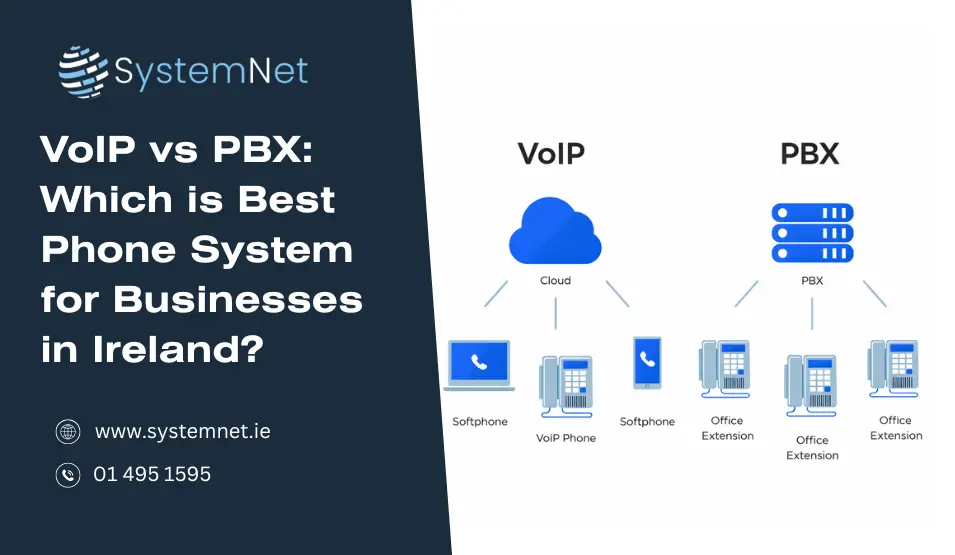
Choosing the right business phone system in Ireland today is no longer just about making phone calls. It affects costs, flexibility, customer experience, remote work capability, and long-term scalability.
Many Irish businesses comparing VoIP vs PBX are upgrading legacy setups, replacing ISDN-based phone lines, or planning for growth. This guide explains the differences clearly so you can decide confidently.
What is a PBX system?
A PBX (Private Branch Exchange) is a business phone system that manages internal and external calls within an organisation. Traditional PBX systems rely on physical phone hardware installed on-site and connect through the public telephone network using dedicated phone lines. The PBX acts as a central switching platform, routing calls between extensions, desk phones, voicemail systems, and outside numbers.
Key characteristics:
- Operates through dedicated physical phone infrastructure
- Installed and maintained on company premises
- Uses SIP trunks or PSTN/PRI connections for external calls
- Requires hardware lifecycle management
- Often supported by in-house IT or telecom engineers
What is VoIP?
VoIP (Voice over Internet Protocol) is a communication technology that transmits voice as digital data across an internet connection instead of traditional phone lines. A VoIP system converts speech into packets, sends them securely through a provider’s data centre, and reconstructs the audio at the receiving device. VoIP technology enables cloud-based, internet-based calling across multiple devices and locations.
Key characteristics:
- Uses existing internet connection rather than dedicated phone lines
- Delivered via cloud-based or hosted VoIP platforms
- Minimal on-site hardware requirements
- Centralised management via web interface
- Supports mobility and remote work
VoIP vs PBX: What’s the core difference?
| Factor | PBX (Private Branch Exchange) | VoIP (Voice over Internet Protocol) |
|---|---|---|
| Infrastructure | Physical phone hardware installed on-site | Cloud-based / hosted platform |
| Connectivity | Dedicated phone lines / SIP trunks | Internet connection |
| Deployment | Office-centric | Location-independent |
| Scalability | Hardware dependent | Software driven |
| Maintenance | On-site IT/vendor visits | Provider managed |
| Flexibility | Limited remote capability | Designed for remote work |
| Upfront costs | High hardware investment | Lower entry costs |
| Expansion | Requires equipment upgrades | Add users instantly |
In simple terms:
- PBX = hardware-centric telephony
- VoIP = internet-based digital communication
The difference is not just technical; it influences how businesses budget, scale, and support modern work environments.
Which is more cost-effective?
Traditional PBX systems involve high upfront costs. Hardware, installation, gateways, licensing, and ongoing maintenance contracts create long-term financial commitments. Expansion usually means additional physical phone equipment and configuration work.
VoIP systems typically shift spending toward predictable operational expenses. Lower upfront investment, bundled voip service plans, reduced call charges, and provider-managed upgrades often result in more cost-effective long-term ownership for many Irish SMEs.
Which is more scalable and flexible?
Scaling a PBX private branch exchange requires planning for hardware capacity. Adding extensions may involve new modules, upgraded controllers, or additional phone lines. Growth can introduce delays and capital expenditure.
VoIP technology allows businesses to add users, numbers, or locations through software. Internet-based provisioning enables rapid expansion, easier remote work support, and flexible deployment without physical infrastructure constraints.
How reliable are VoIP and PBX in Ireland?
PBX systems are traditionally seen as stable because they rely on dedicated circuits. However, reliability depends on hardware health, power continuity, and maintenance responsiveness. Equipment failure can still cause downtime.
VoIP reliability in Ireland largely depends on internet connection quality and network design. With fibre broadband, redundancy, QoS configuration, and resilient data centre infrastructure, modern VoIP systems can deliver excellent call quality and uptime.
Why are Irish businesses moving away from legacy PBX?
Reason 1: Ageing Infrastructure Challenges
Many legacy PBX installations in Ireland operate beyond the recommended hardware lifecycle. Replacement parts, vendor support limitations, and compatibility constraints increase operational risk and create unpredictable maintenance scenarios for business continuity planning.
Reason 2: Rising Maintenance Costs
Support contracts, specialist engineer visits, hardware failures, and software licensing renewals significantly increase the total cost of ownership. Businesses often discover that maintaining older systems costs more than transitioning to newer cloud-based alternatives.
Reason 3: Limited Remote Work Support
Traditional PBX systems were designed for fixed office environments. Supporting hybrid teams requires complex VPNs, SBCs, or call forwarding workarounds, which add cost and technical overhead without delivering true mobility.
Reason 4: Scalability Limitations
Business growth demands flexibility. Expanding a PBX system typically requires new hardware modules, additional phone lines, and configuration changes, slowing down scaling initiatives compared to software-driven VoIP platforms.
Reason 5: Digital Transformation Strategy
Irish organisations modernising IT infrastructure increasingly align communications with cloud-first strategies. Integrations, analytics, mobility, and unified communications capabilities favour internet-based VoIP system adoption over hardware-centric PBX models.
What about ISDN phase-out & modernisation?
The ISDN switch-off forced many Irish businesses to reassess their type of phone system. Traditional voice services delivered over legacy phone lines required replacement with SIP or VoIP alternatives, accelerating telecom modernisation decisions.
For many organisations, this shift became an opportunity to evaluate hosted PBX, VoIP voice over internet solutions, and cloud-based communication platforms rather than simply replicating legacy infrastructure with newer hardware.
When does PBX still make sense?
Highly Controlled IT Environments
Organisations requiring strict on-premise control, an isolated telephone network infrastructure, and internally governed call routing may prefer PBX. This is common where regulatory frameworks or internal policies restrict cloud-based or internet-based communication systems.
Existing Hardware Investment
Businesses with recent capital investment in traditional PBX systems, gateways, desk phones, and switching equipment may choose to extend lifecycle value rather than replace infrastructure prematurely, especially when systems remain stable and supported.
Limited Internet Reliability
Locations with unstable internet connection performance, insufficient bandwidth, or high latency risk may prioritise physical phone connectivity. Consistent call quality under variable network conditions can influence decisions in rural or remote Irish regions.
Specialised Telecom Integration
Some enterprises operate tightly integrated voice environments involving legacy paging systems, analogue devices, security platforms, or manufacturing interfaces. Replacing a PBX private branch exchange may introduce operational disruption or complex redesign requirements.
Predictable Static Workforce
Businesses operating entirely from fixed office locations with minimal remote work needs may find traditional PBX systems operationally adequate. When employee mobility and flexible work patterns are not priorities, PBX constraints become less critical.
When is VoIP the better choice?
Remote & Hybrid Workforces
VoIP systems are designed for mobility. Employees can transmit voice, manage phone calls, and handle external calls from laptops, softphones, or mobile devices anywhere with a reliable internet connection.
Rapid Business Growth
VoIP technology allows companies to add users instantly without purchasing physical phone modules or expanding hardware capacity. Scaling becomes software-driven rather than infrastructure-restricted.
Multi-Location Operations
Cloud-based VoIP systems connect offices, remote teams, and satellite locations under a unified communications environment. No need for separate PBX hardware per site.
Cost Optimisation Strategy
Lower upfront costs, bundled voip service plans, reduced call charges, and predictable monthly pricing often deliver a more cost-effective ownership model for Irish SMEs.
Advanced Feature Requirements
Modern VoIP platforms typically include advanced features such as call analytics, CRM integrations, auto attendants, mobile apps, call recording, and reporting tools not easily replicated on legacy PBX systems.
What features do VoIP & PBX offer?
Call Handling & Routing
Both PBX private branch exchange and VoIP system platforms support call transfer, voicemail, call queues, IVR menus, and routing rules. However, VoIP environments often allow more granular software-based configuration without hardware dependency.
Device Support
Traditional PBX systems primarily support desk phones and fixed endpoints. VoIP technology extends compatibility across desk phones, softphones, mobile apps, and browser-based calling interfaces.
Mobility & Accessibility
VoIP voice over internet solutions enables users to manage business phone system functions remotely. PBX environments typically require forwarding rules or VPN-dependent access.
Analytics & Reporting
Cloud-based VoIP systems frequently include built-in dashboards for monitoring call quality, usage patterns, and performance metrics. Legacy PBX reporting capabilities may require additional modules or external software.
Integration Capabilities
VoIP platforms commonly integrate with collaboration tools, helpdesk software, CRM systems, and productivity suites. Traditional PBX integration may involve proprietary connectors or complex middleware.
What are the drawbacks of VoIP and PBX?
| Factor | PBX Limitations | VoIP Limitations |
|---|---|---|
| Infrastructure | Hardware lifecycle & failures | Internet dependency |
| Upfront Costs | High capital investment | Lower but subscription-based |
| Scalability | Hardware expansion required | Bandwidth planning needed |
| Flexibility | Limited remote work support | Requires network readiness |
| Maintenance | On-site support needed | Provider reliance |
| Mobility | Office-centric | Dependent on connectivity |
| Disaster Recovery | Hardware redundancy costly | Requires a failover design |
No system is universally perfect. The right decision depends on business model, risk tolerance, budget structure, and growth trajectory.
How do you choose between VoIP and PBX?
Evaluate Business Growth Plans
If expansion, hiring, or multi-site operations are expected, VoIP scalability advantages often outweigh PBX hardware constraints. Static organisations may prioritise different considerations.
Assess Cost Structure Preferences
Businesses preferring operational expenditure may lean toward VoIP systems. Organisations favouring capital ownership models may still consider PBX private branch exchange investments.
Analyse Workforce Mobility
Remote work, hybrid teams, and mobile employees strongly favour internet-based VoIP system deployment rather than fixed physical phone infrastructure.
Review IT & Support Capabilities
Traditional PBX systems require hardware expertise. Cloud-based VoIP environments reduce internal maintenance burden but shift responsibility toward provider partnership.
Consider Risk & Continuity Strategy
Evaluate power redundancy, internet failover, disaster recovery planning, and uptime requirements. Reliability design matters more than the technology label.
Need help evaluating your phone system options?
Choosing between private branch exchange and VoIP solutions requires technical, operational, and financial evaluation.
SystemNet provides both VoIP phone systems and PBX solutions for Irish businesses, supporting organisations transitioning from traditional PBX systems, deploying hosted PBX, or implementing fully cloud-based voice over internet protocol platforms.
Get in touch with our specialists and find the best-fit phone system for your business environment.
Key Takeaways
- PBX private branch exchange systems remain viable in specific controlled environments
- VoIP voice over internet solutions dominates modern flexibility and scalability needs
- Upfront costs vs operational costs significantly influence decision strategy
- Remote work demands often eliminate traditional PBX practicality
- Hosted PBX bridges legacy familiarity with cloud-based benefits
FAQs
Q. Is VoIP suitable for small Irish businesses?
VoIP systems offer cost-effective deployment, low upfront costs, scalability, and advanced features ideal for SMEs requiring flexibility and remote work support.
Q. Can VoIP work with desk phones?
VoIP technology supports compatible desk phones, softphones, and mobile devices using the same business phone system across locations.
Q. Does PBX provide better call quality than VoIP?
Modern VoIP systems can deliver excellent call quality when supported by a stable internet connection, QoS configuration, and provider-grade data centre infrastructure.
Q. What happens if the internet goes down?
VoIP systems can reroute phone calls to mobiles or backup sites if failover and continuity mechanisms are properly configured.
Q. Can businesses combine PBX and VoIP?
Hybrid models using SIP trunking allow traditional PBX systems to transmit voice over internet connections without fully replacing infrastructure.
Q. Is hosted PBX the same as VoIP?
Hosted PBX uses VoIP voice over Internet Protocol technology but provides PBX-style call control features via cloud-based delivery.