
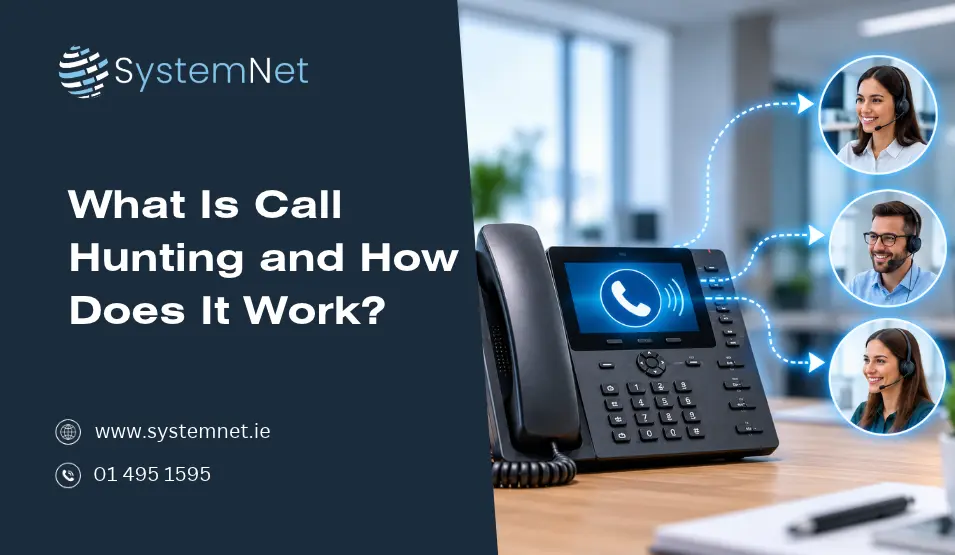
Call hunting is a business phone system feature that routes an incoming call to a group of people or extensions according to a defined calling pattern. Instead of leaving a caller dependent on one busy or unavailable employee, the phone system can try other members of the group until the call is answered.
For businesses, the aim is simple: get incoming calls to an available member of the team as efficiently as possible. Call hunting is particularly useful for small teams, sales departments, service teams and businesses where several employees share responsibility for answering the same business number.
What Is Call Hunting?
Call hunting, sometimes called line hunting or a hunt group, is a call-routing method that distributes incoming calls across multiple phone lines or extensions. The exact behaviour depends on how the phone system is configured. A business may choose to ring staff one after another, ring several extensions at once, or distribute calls across team members using a defined pattern.
The important distinction is that the caller uses a business number, while the phone system decides which available person or extension should receive the call. This can make call handling more flexible than relying on a single desk phone.
How Does Call Hunting Work?
A typical call-hunting setup works in a few straightforward stages:
- An incoming caller dials the business number.
- The phone system identifies the configured hunt group or call-routing rule.
- The system sends the call to one or more members of the group according to the selected ringing pattern.
- If the first destination does not answer, the system moves to the next configured destination where applicable.
- The call is answered by an available team member or follows the configured fallback route.
The exact routing rules, ringing order and fallback behaviour depend on the phone system and its configuration. Businesses should therefore confirm the available routing options with their provider rather than assuming every call-hunting system works in exactly the same way.
Sequential Call Hunting
With sequential hunting, the system tries members of the group in a defined order. For example, a call might ring Employee A first, then Employee B, followed by Employee C if the earlier destination does not answer.
This approach can be useful where a business wants a clear first point of contact while still providing backup coverage.
Simultaneous Call Hunting
With simultaneous ringing, multiple members of the hunt group can be alerted at the same time. The first suitable person to answer takes the call. This can be useful for small teams where everyone shares responsibility for incoming enquiries.
Round-Robin Call Hunting
A round-robin approach distributes calls around a group rather than continually starting with the same person. Depending on the platform, other distribution rules may also be available. The objective is to spread incoming call handling more evenly across the team.
Call Hunting vs Call Queuing vs Ring Groups
These features can sound similar, but they solve different call-handling needs.
Call hunting: Routes an incoming call across a configured group of people or extensions according to a defined hunting pattern.
Call queuing: Places callers into a queue when staff are unavailable, allowing them to wait until an agent becomes available.
Ring groups: Groups multiple extensions so that a call can ring selected team members together or according to configured rules.
A business phone system can use several of these features together. For example, a hunt group may handle the first stage of routing, while a queue or voicemail provides a fallback when nobody is available.
Benefits of Call Hunting for Businesses
Reduce Missed Business Calls
When responsibility for an incoming number is shared across several team members, call hunting can give the business more opportunities to answer the call before it reaches a fallback destination.
Connect Callers With Available Staff
Instead of relying on one employee to remain beside a particular phone, a configured hunt group can direct calls to other members of the team. This can be useful when employees are handling different tasks during the day.
Improve Response Times
Getting an incoming call to an available employee quickly can help reduce unnecessary waiting and make the customer experience more responsive.
Support Small and Growing Teams
Small businesses often have employees covering more than one role. Call hunting can help share responsibility for the main business number without requiring every caller to know individual direct numbers.
When Should a Business Use Call Hunting?
Call hunting can be worth considering when several employees need to answer the same business number and calls are regularly missed because the first person contacted is unavailable.
- Small businesses with shared incoming enquiries
- Sales teams handling new leads
- Customer service or support teams
- Businesses with staff moving between desks or locations
- Teams that need a shared main number rather than one employee’s direct line
It may be less suitable when callers need to wait for a specific specialist. In that situation, a queue, IVR, direct dialling or another routing method may be more appropriate.
Is Call Hunting Available With VoIP Phone Systems?
Yes, call hunting is a feature offered by modern VoIP and cloud-based business phone systems. The available routing methods depend on the provider and platform.
SystemNet’s VoIP Phone System includes Call Hunting as a feature. Call Hunting can distribute incoming calls across multiple team members until someone answers. This functionality is also available within a small business phone system, helping route calls to available staff.
How SystemNet Supports Call Handling
SystemNet provides cloud-based business telephone systems for businesses in Ireland, with call handling features including Call Hunting, Call Queuing, Call Forward, Call Transfer, Ring Groups, Digital Receptionist, Voicemail and Call Recording.
For businesses considering Call Hunting, the right configuration depends on how calls arrive, who needs to answer them, working hours, team availability and what should happen when nobody answers. SystemNet can help businesses assess their requirements and configure an appropriate cloud phone system.
Frequently Asked Questions About Call Hunting
What is call hunting in a phone system?
Call hunting is a call-routing feature that sends an incoming call to a configured group of phone lines or extensions according to a defined ringing pattern.
What is a hunt group?
A hunt group is a group of extensions or destinations configured to receive calls according to a particular routing rule.
Does call hunting reduce missed calls?
It can help reduce missed calls by giving an incoming call more than one configured destination before the system uses its fallback route.
What is the difference between call hunting and call forwarding?
Call forwarding generally redirects a call to another destination, while call hunting distributes or tries the call across multiple configured destinations.
Is call hunting the same as a ring group?
They are related but not necessarily identical. A ring group groups extensions for shared ringing, while call hunting specifically describes distributing or trying calls across a group according to configured hunting rules.
Can small businesses use call hunting?
Yes, it can be particularly useful for small teams where several employees share responsibility for answering the main business number.
Does SystemNet offer call hunting?
Yes, call Hunting is included in SystemNet’s VoIP Phone System and Small Business Phone System.
Can call hunting work with a cloud phone system?
Yes, call hunting can be configured as part of a cloud-based business phone system when the provider supports the feature.
Choose the Right Call Routing Setup for Your Business
Call hunting is one way to make incoming business calls easier to manage, but the best setup depends on how your team works. If calls need to be shared between several employees, a hunt group may be appropriate. If callers need to wait for the next available agent, call queuing may be a better fit. If callers need to choose a department, an auto attendant or IVR can help route them.
SystemNet provides cloud-based business phone systems for organisations across Ireland. Speak to the SystemNet team about your call volumes, team structure and routing requirements to find a setup that fits your business.